
Tunable White Lighting: when light adapts throughout the day
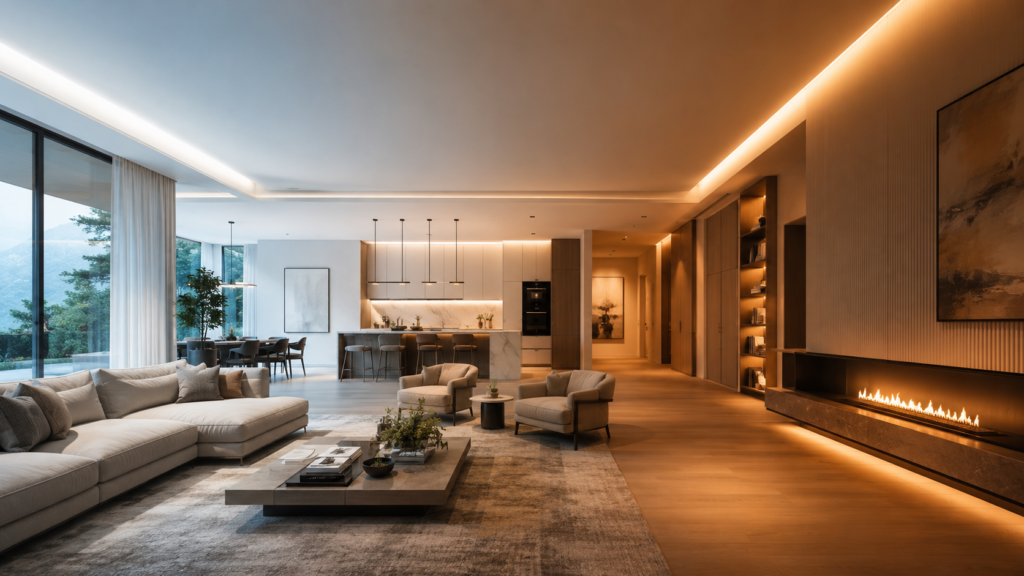
Not all white light is the same
When selecting a light fixture, we naturally consider its design, output and position.
Another factor, however, has a major impact on how an interior feels: color temperature.
Measured in Kelvin (K), it describes the tone of white light.
Around 2,700 K, light feels warm and recalls traditional incandescent lamps. As the value increases, white light becomes progressively more neutral and then cooler.
This difference has a significant influence on how we experience a room.
Warm light can reinforce the welcoming character of a living room in the evening, while clearer, more neutral light can be particularly comfortable in a kitchen, office or daytime workspace.
Traditionally, however, the color temperature had to be selected when the lighting fixtures were specified.
Tunable White changes that approach.
What is Tunable White?
Tunable White, sometimes referred to as dynamic white lighting, makes it possible to change the color temperature produced by the same fixture.
Light can therefore evolve throughout the day:
- brighter and clearer in the morning;
- more neutral during daytime;
- gradually warmer in the late afternoon;
- soft and relaxing in the evening.
This can also be controlled independently from brightness.
In other words, we can choose not only how much light we want, but also what quality of light is appropriate for the moment.
Lighting becomes truly dynamic.
Why is dynamic lighting relevant in a home?
A single room can serve very different purposes throughout the day.
Consider an open-plan kitchen and living room.
In the morning, it is where breakfast is prepared.
During the day, natural daylight may dominate the room.
In the late afternoon, the kitchen island may become a workspace or somewhere for children to do their homework.
Later, the same space is used for dinner, entertaining and relaxation.
Why should the lighting remain identical in all of these situations?
Dynamic lighting allows the atmosphere of a room to change without changing its architecture.
This is one of the most compelling aspects of Tunable White: light becomes a true material for interior design and comfort.
Scenes rather than technical settings
A well-designed system should never require its users to constantly choose between 2,700 K, 3,000 K or 4,000 K.
Those parameters should remain in the background.
What matters to the user are lighting scenes.
Morning
Motorised shades open.
Clear, comfortable lighting complements natural daylight and supports the start of the day.
Functional areas such as the kitchen receive the appropriate level of illumination.
Daytime
Artificial lighting simply supplements daylight when necessary.
Less important circuits can remain switched off or operate at very low levels.
Dinner
The light gradually becomes warmer.
Overall brightness is reduced and decorative lighting becomes more prominent.
The atmosphere instantly feels more welcoming.
Evening
Indirect and accent lighting takes over.
The environment becomes softer and more intimate.
Cinema
Main lights fade gradually.
Very subtle pathway lighting can remain active for comfortable movement through the room.
A single command can activate each of these scenes.
The complexity stays behind the walls. The experience should remain extremely simple.
Working with natural daylight
One of the most elegant applications of Tunable White is to allow interior lighting to evolve alongside daylight.
Natural light is never completely constant.
Its brightness and tone change throughout the day.
A well-designed lighting system can accompany those variations rather than operating as an entirely separate environment.
The transition between daylight and artificial light then becomes much more subtle.
When properly configured, the user should barely notice that the lighting is changing.
They should simply feel that the light is right for that moment.
Light also changes how materials are perceived
Color temperature also influences the way we experience interior architecture.
Wood, natural stone, fabrics, paint finishes, artwork and furniture all react differently under different qualities of light.
Warmer tones can enhance certain woods and textiles.
More neutral light can provide more accurate color perception or highlight particular architectural details.
This is why lighting should be considered alongside materials and interior design.
Light should not simply illuminate architecture. It should reveal it.
Tunable White and Warm Dim: what is the difference?
The two technologies are sometimes confused.
Warm Dim mainly recreates the behaviour of a traditional incandescent lamp: as the light is dimmed, its tone automatically becomes warmer.
This can be particularly attractive in living rooms, bedrooms and entertainment spaces.
Tunable White offers greater flexibility.
Brightness and color temperature can be controlled independently.
This means a room can have bright warm light, or conversely lower-intensity light with a more neutral tone.
Both approaches are useful, but they serve different purposes.
Not all Tunable White lighting is equal
The term “Tunable White” alone does not guarantee the quality of an installation.
Several factors are important:
- LED quality;
- color rendering and accuracy;
- available color-temperature range;
- color consistency;
- low-level dimming performance;
- smoothness of transitions;
- driver and power-supply quality;
- compatibility between fixtures and control systems.
A successful installation therefore depends as much on system design and implementation as it does on the individual products chosen.
What happens behind the light?
For the homeowner, everything should remain simple.
For the integrator, however, Tunable White requires an appropriate technical architecture.
Several approaches are available.
In professional installations, protocols such as DALI DT8 can, for example, transmit both brightness and color-temperature information to compatible LED drivers.
The driver then controls the LED sources required to produce the requested shade of white.
Other architectures are possible depending on the control system and fixtures selected.
This technical layer may be invisible to the homeowner, but it is essential because it determines transition quality, system reliability and future flexibility.
Why should it be considered before ceilings are closed?
In many construction and renovation projects, lighting is still considered too late.
Spaces are designed.
Ceilings are defined.
Electrical circuits are prepared.
Then the fixtures are selected.
Only afterwards is their control considered.
Reversing this process can often produce a much more refined result.
From the design stage, it is possible to consider:
- natural daylight;
- how each room will be used;
- required lighting levels;
- direct and indirect lighting;
- architectural features to highlight;
- lighting scenes;
- color temperatures;
- motorised shading;
- drivers and power supplies;
- cabling and control buses.
Architect, electrician, lighting designer and systems integrator can therefore work towards a common objective.
Technology becomes a tool serving architecture, rather than a constraint added at the end of the project.
The best technology is often the technology you stop noticing
When people think about smart homes, they often imagine apps, touchscreens and voice control.
Yet some of the most valuable technologies are almost invisible.
Tunable White is a perfect example.
A successful system does not require the homeowner to become a lighting expert.
They simply select: Morning / Daytime / Dinner / Entertaining / Cinema / Good night
And the home adapts its environment automatically.
Lighting control, natural daylight and motorised shading can work together to create environments that suit every moment of the day.
That is often what successful integration really means:
a great deal of design thinking and technology behind the scenes, creating an exceptionally simple everyday experience.
Building or renovating your home?
Jer’Home Solutions supports homeowners, architects and professionals in designing lighting and ambiance-management solutions tailored to the architecture and intended use of each project.
Lighting control, Tunable White, lighting scenes, motorised shading, integrated audiovisual systems and network infrastructure can all be considered together from the design stage to create a comfortable, coherent and easy-to-use home.
Let’s talk about your project.